
The Data Operating System
A data system your whole team runs on.We set it up. We calibrate it. You own it from day 1.
We embed as your fractional data team, connect everything in weeks, and don't stop until your ads, product, SEO, and strategy all run on answers you can trust.

Trusted by operators of high growth brands
The problem
Two years ago, your problem was slow answers. Getting a number meant tickets, queries, waiting.
That problem is gone. Now everyone on your team gets an answer in four seconds — from GA4, from five dashboards, from an AI that answers confidently whether or not it's right.
So the arguments changed. It's no longer "when will I get the number." It's "which number is real."
And that argument has no owner. Your CTO owns the pipes. Marketing owns the tools. The AI owns nothing. Definitions live in three people's heads, and every real decision waits for the argument to end.
Whoever owns the trusted version of the truth owns the decisions. At most companies, that seat is empty.
Make better marketing decisions by talking to your insights
This is what makes it an operating system instead of another dashboard tool.

Plugs into the stack you already run


01
Data flows in
Your CRM, ads, product, payments, and support desk. Synced and modeled on the way in, not dumped raw.
02
Stored with your definitions
It all lands in a BigQuery you own, run by our team and shaped by your metric glossary. Revenue means one thing, everywhere.
03
Accessed by people and AI
Reports read it live. Your MCP gives Claude, Cursor, or any AI client the same governed data. Definitions first, always.
Inside the Data Operating System
The real system, not mockups. This is what your team gets.
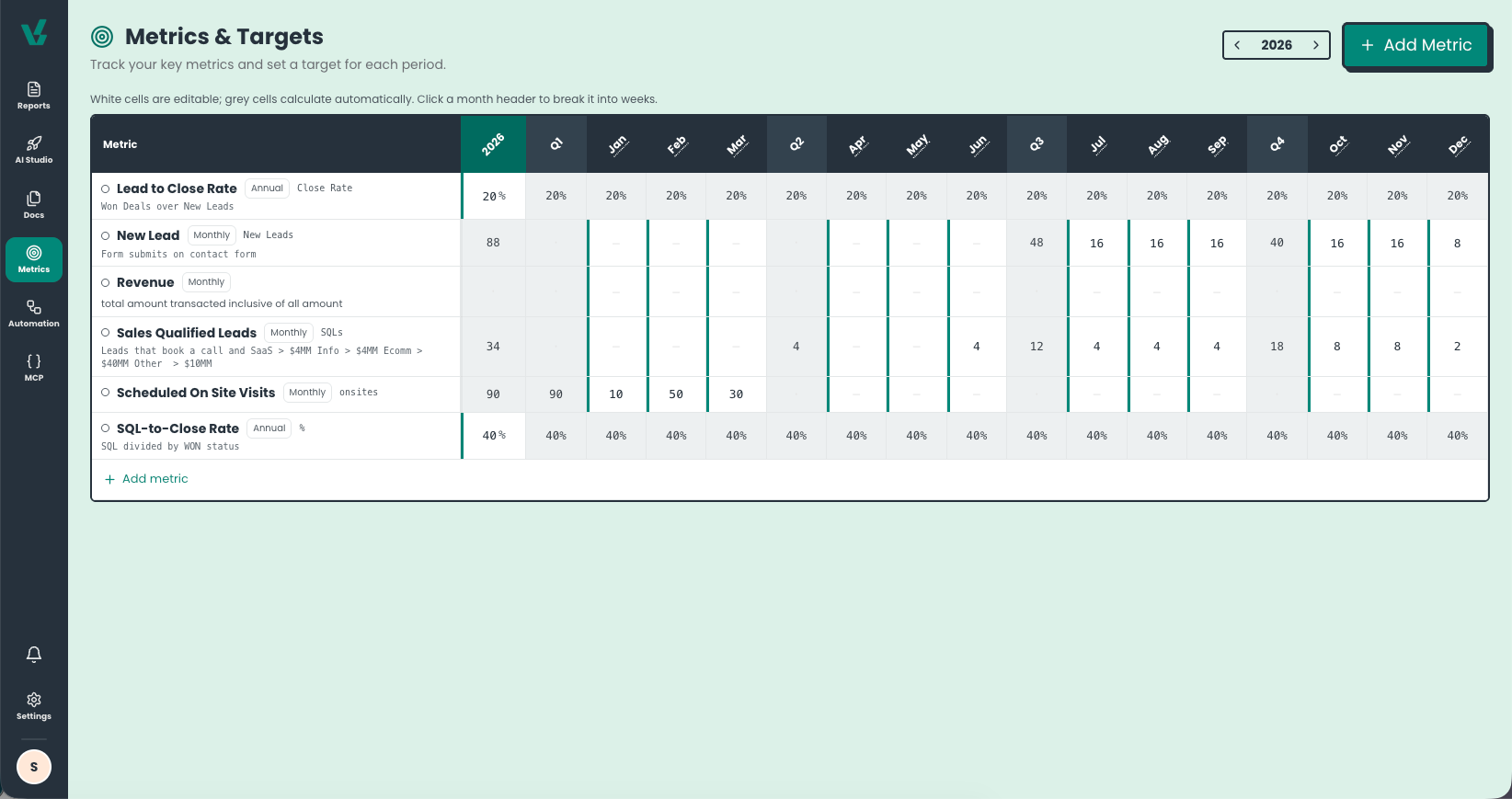
The metric glossary
Define every metric once
Revenue, qualified lead, close rate, CAC. Written down with targets by month and quarter. Every report and every AI answer inherits the same definitions, so the argument happens one time instead of every Monday.
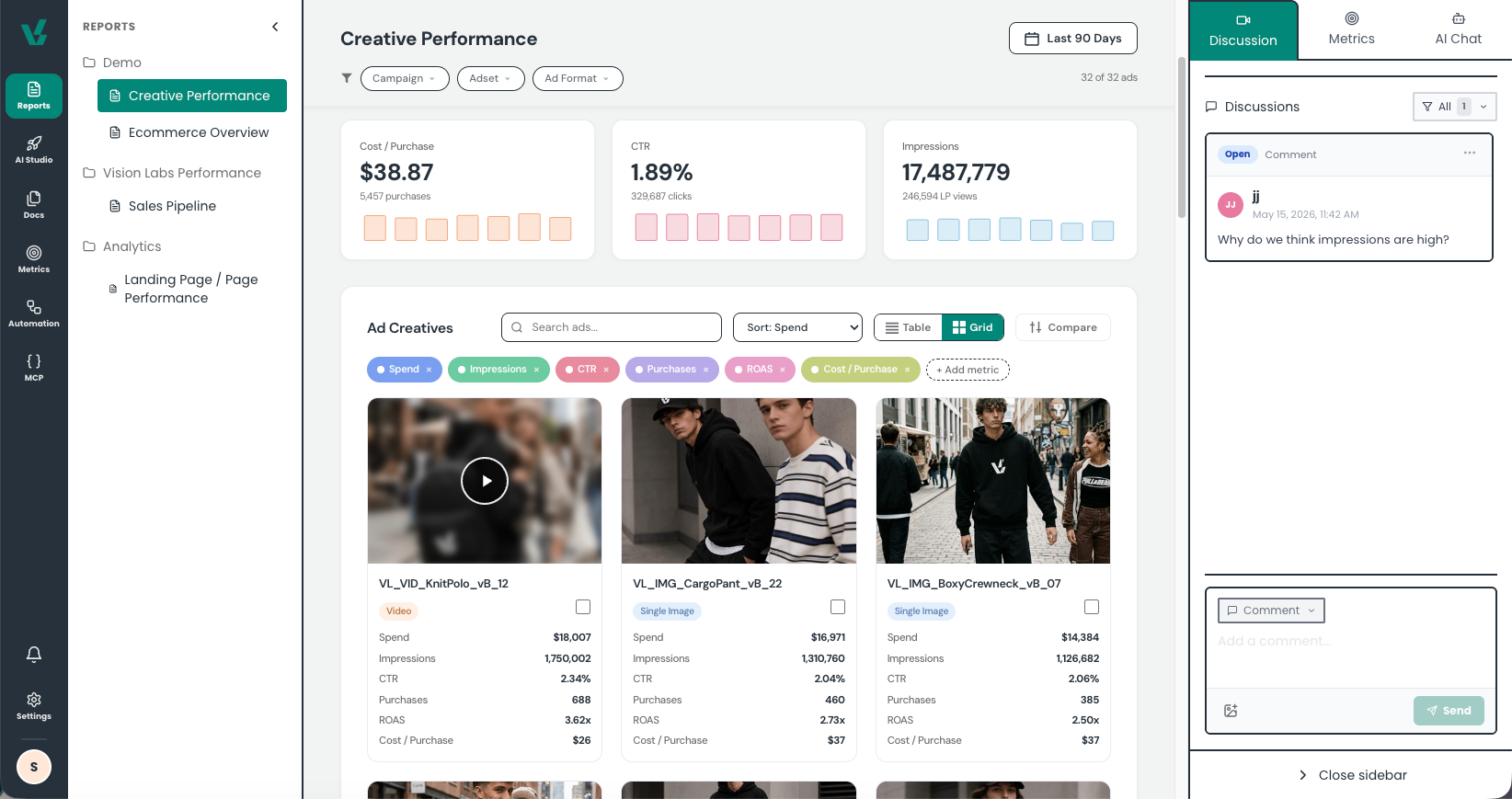
The report home
Reports that live somewhere
Living, interactive reports in one UI. Filter, compare, drill in. They refresh on their own and the whole team looks at the same thing. No more orphaned files.
Drill-ins
Every number opens up
Click any ad, any row, any metric. You get the trend, the comparison against your account average, the copy, the destination. The "wait, why?" question gets answered on the page.
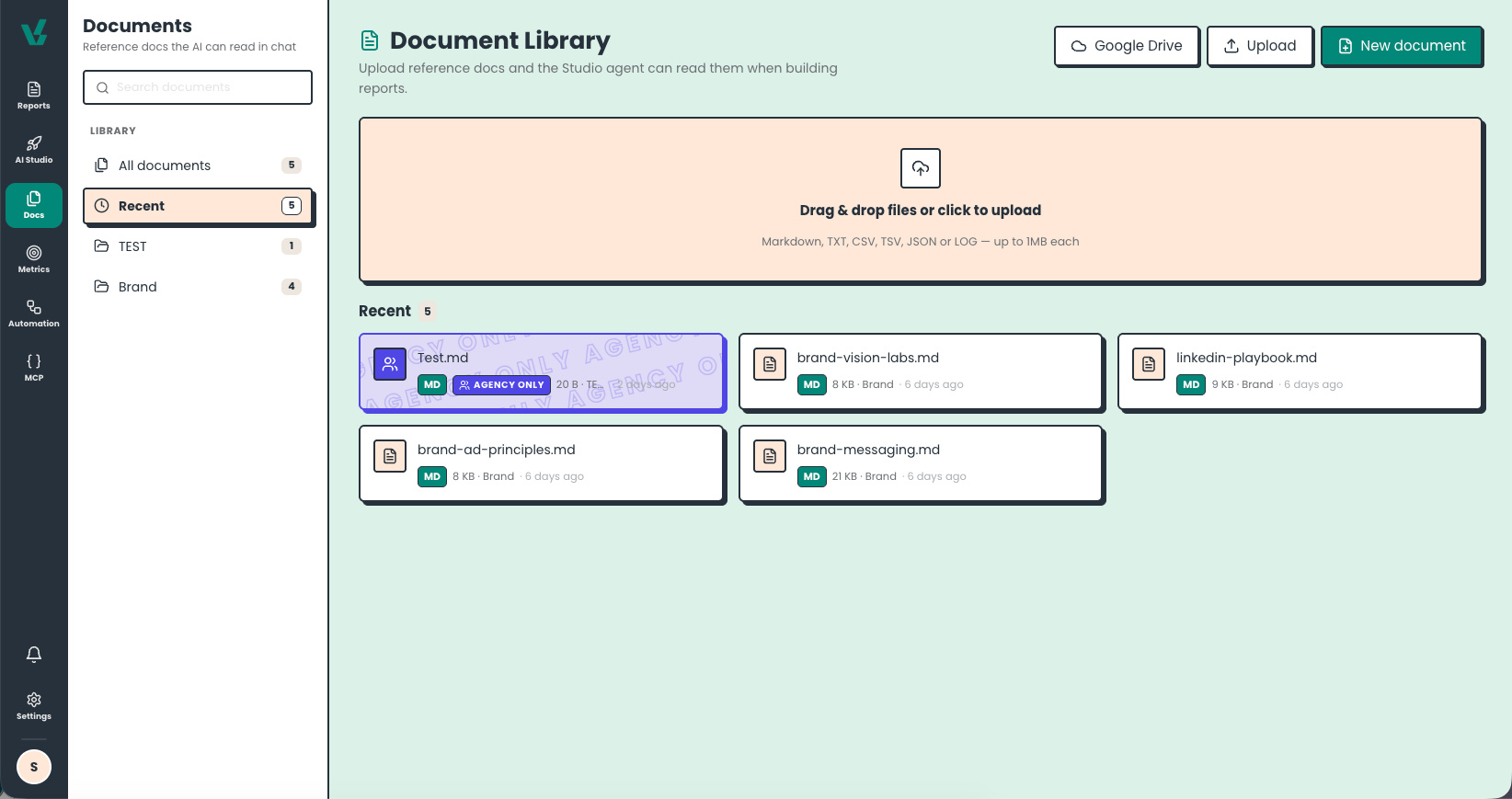
The context warehouse
Context that keeps up
Call recordings, strategy conversations, north stars and missions, goals and targets. A synced Drive folder and your call transcripts keep it current, so the answers sound like your business this quarter, not a chatbot reading last year's deck.
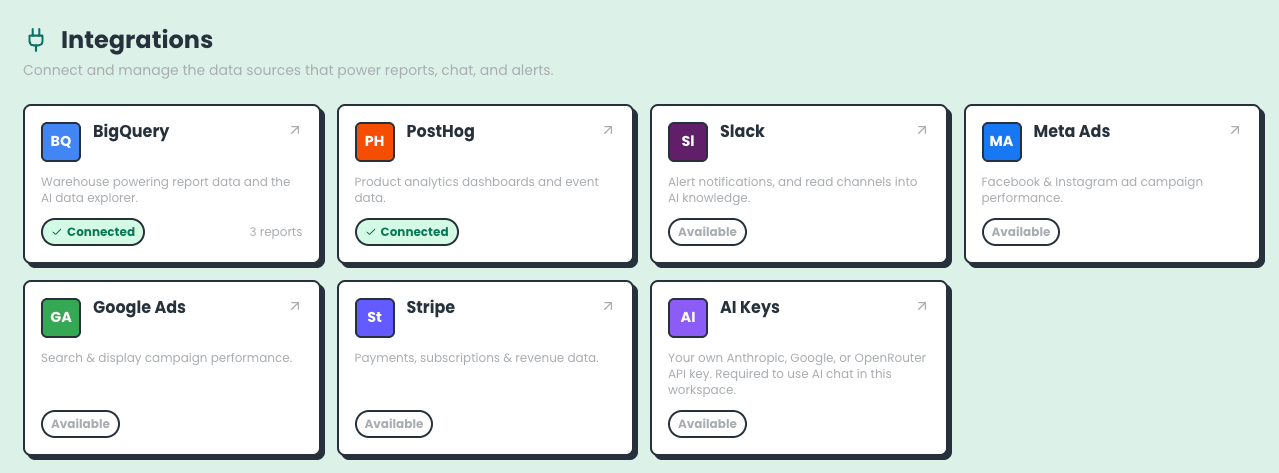
Connections
Plugged into your stack
PostHog, GA360, BigQuery, your ad platforms, your CRM, Stripe, Slack. If it holds a number you care about, it flows in.
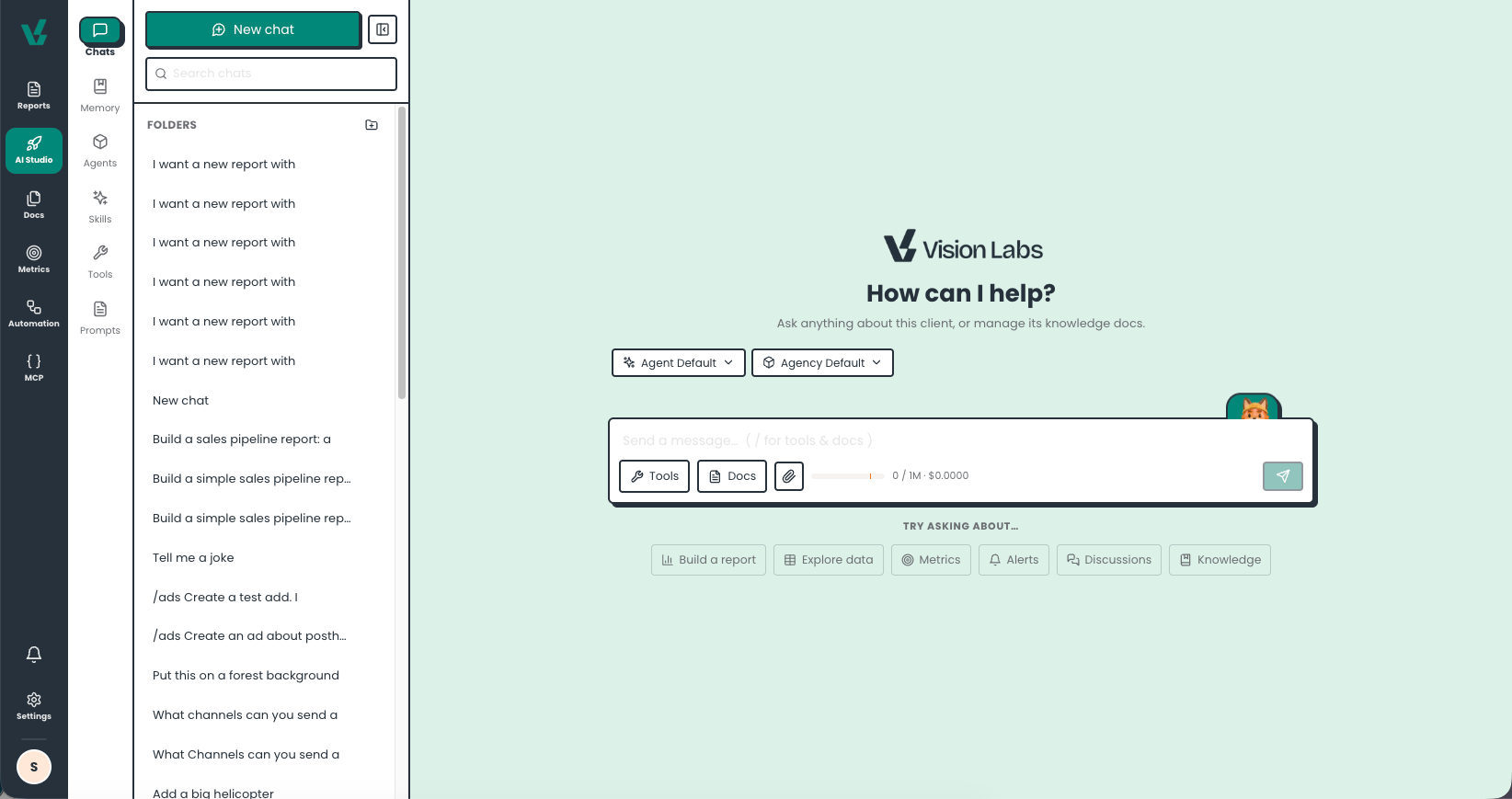
The AI studio
A chat that knows your business
Ask for a report, a number, or an alert in plain English. It answers from your glossary, your docs, and your validated reports. In the built-in chat, in Claude, or in Cursor.
Teams that stopped arguing about their numbers
Find the role that sounds like you. This is what changed when the system got fixed.
Sales more than doubled in 18 months
They have been incredibly attentive and detailed from the start. Our sales have more than doubled in less than 18 months. I know that every cent I spend on marketing is being accounted for. We can maximize our marketing dollars in the areas where we achieve the highest ROI.
 Darla Torkelsen
CEO
Darla Torkelsen
CEO
Reports people actually read and act on
We've recommended JJ and the Vision Labs team numerous times and they've always managed to continually impress. Time and time again, they've proven their ability to collect the right data, organize it in a way that tells a natural story, and display it in reports that are both easy to read and highly actionable.
 Chris "Mercer"
Co-Founder
Chris "Mercer"
Co-Founder
Knows exactly where to invest for growth
Vision Labs is an integral part of monitoring and measuring our business. Their reporting helps us understand where to invest for new customer growth. They assist us in providing solutions to attribution, tracking, customer behaviour, etc. I highly recommend working with them!
 Heather Thomas
E-Commerce Director
Heather Thomas
E-Commerce Director
Found the problems nobody thought to check
Incredible at both execution and education. We knew there were many problems with our web data, but Vision Labs uncovered things we didn't even think to check — and educated our internal teams on the why behind them. I honestly can't think of anything for Vision Labs to improve on.
 Alex Birkett
Founder
Alex Birkett
Founder
Complex data made usable for decisions
Vision Labs was instrumental in getting our data into a usable format with Looker. They took a hugely complicated scenario and steadily refined it for us so we could make critical business decisions. Would definitely recommend their team!
 Joshua Beam
CTO
Joshua Beam
CTO
A GA4 migration without the drama
Vision Labs helped my team transition from UA to GA4 smoothly. They were knowledgeable, created a custom plan, and were always available to answer questions. They had deep expertise in all things Google Analytics, I would highly recommend them.
 Michael Jaron
Head of Data
Michael Jaron
Head of Data
Included in every engagement, at no extra charge
- Every source you run, connected. No per connector fee
- Every person on your team, with access. No per seat fee
- The storage bill for your warehouse
- Pipeline repairs when a platform changes its API
- New reports as the questions change
- Your org's MCP, so Claude and Cursor read the same governed data
Get on a call and we'll show you exactly where you're leaving money on the table
Whatever we find, we'll tell you straight what we'd do about it.
- Where your numbers diverge We map the systems that disagree and name which one is lying, on the call, not in a follow-up deck.
- A governed warehouse, running Not a mockup. A live dashboard on real data with the metric definitions sitting underneath it.
- The definitions you're arguing about The three metrics your team quietly defines differently, and what that disagreement is costing you.
- Scoped to your actual stack What this looks like on your sources, your CRM, and your team size. Not a generic roadmap.
- An honest read Including when the answer is that you do not need us. We would rather tell you than sell you.
Bring the person who signs. 30 minutes with JJ, zero pitch.
Questions
What does it cost?
It depends on scope: how many sources you run, how broken the tracking is, and how much reporting your team needs. We scope before we quote, so there are no surprise invoices, and you leave the first call with a number. Prefer a one-time setup? We build the system, hand you the keys, and scope it as a project. Either way: no per-seat pricing, no usage meters, and you are not paying for the AI twice.
If you are still weighing this against hiring someone or buying more tools, we put both options side by side, with sources.
Why not just use HubSpot or Salesforce reporting?
Because your CRM can only report on what is inside your CRM. Ad spend sits in Google and Meta. Product usage sits in your app. Payments sit in Stripe. Support sits in your help desk. The moment a question crosses two of those, CRM reporting runs out, and someone starts building a spreadsheet.
There is a second problem that shows up later. Filters that work on one source break across several, so teams end up keeping one dashboard for 90 days, one for 180, and one for the year. That is the whole point of not having dashboards.
Our CRM data is messy. Reps don't fill in the fields.
Everyone's is. A CRM records what a person remembered to type, which is why "close rate" moves when nobody changed the business. That is a definitions and tracking problem, and it is the first thing we fix, not something you have to clean up before we start.
In practice: the events that can be captured automatically get captured automatically, the fields that genuinely need a human get narrowed down to the few that matter, and the glossary states what a stage means so it stops drifting. We tell you which numbers are trustworthy today and which ones need a process change first.
Who owns the data and the systems?
You do. The data, the warehouse, the tracking, and the reports all live in accounts you own. Our expert team runs the system day to day so everything stays smooth, but if we ever part ways, everything keeps working and everything stays yours. No lock-in, nothing held hostage.
We're on Snowflake, not BigQuery.
We build on Google Cloud, so BigQuery is our home turf. If you're committed to Snowflake, book the call anyway and we'll give you an honest read on whether the fit is there. We'd rather tell you no than sell you a bad setup.
We already have a data team. Does this still fit?
Yes, and that's often where the pain is loudest. Your data team keeps the core architecture and board-level reporting. The Data OS handles the long tail of tracking fixes, pipeline maintenance, and self-serve requests that sit in their backlog for months.
We don't have a data team at all. Is this for us?
That's the default setup. The warehouse, the pipelines, and the reporting all come managed. You get an embedded data team without hiring one. Most of our clients between $1M and $100M run exactly this way.
What tools do you work with?
GA4 and GA360, Google Tag Manager, PostHog, BigQuery, Looker Studio, plus your ad platforms (Meta, Google Ads, TikTok), your CRM (HubSpot, Salesforce), commerce and billing (Shopify, Stripe), and Slack for alerts. If it holds a number you care about, we can bring it in.
How is this different from hiring an agency or an analyst?
A traditional agency gives you dashboards and leaves the tracking broken underneath. An in-house hire costs $120K+ and still needs the infrastructure built. Vision Labs is an embedded data team: we own the whole system (tracking, warehouse, reports, AI access) and you own the decisions.
How do you keep AI answers from being wrong?
Definitions live in your metric glossary, not in the prompt. Every answer states which definition it applied and what range it used, and reports go through a validation tier before they roll out company-wide. Same AI your team already uses. It just stops guessing.
How does the Context Warehouse stay current?
A synced Drive folder picks up strategy docs and memos as your team writes them. Call recordings and transcripts get ingested, so a decision made on Tuesday's call is in the context by Wednesday. Goals and targets live in the glossary, so when a number changes, every answer after that uses the new one.
Nobody has to remember to re-upload anything. Stale context is worse than no context, because the AI sounds just as confident either way.
Is our data safe?
Everything lives in a warehouse wired to your billing account, access runs through service accounts you can audit, and the AI layer pulls only the data a question actually needs. API traffic isn't used to train anyone's models.
What happens after I book?
A 30-minute call with the Vision Labs team. We map your current stack, where tracking breaks, and where reports lose trust. If it's a fit, we scope the build. If not, you leave with a prioritized plan anyway.
Book a quick intro call.
30 minutes with JJ. Zero pitch. You'll leave knowing exactly what to fix, whether we work together or not.